



Pneumatic Hydraulic Hose Crimper
At TINOFLEX, we take immense pride in being a trusted leader in providing hydraulic hose assembly soultion. With an unwavering commitment to excellence, innovation, and customer satisfaction, we have earned a reputation for delivering top-quality products that cater to diverse industries worldwide.
Why Choose Us
Our Factory
At TINOFLEX, we have a building area of over 1,500 square meters. Our team consists of more than 300 employees. We are proud to have over 100 partners and bring 20 years of experience to our work.
Product Range
TINOFLEX offers a comprehensive range of products designed to meet various fluid transfer needs. From precision hose crimping machines and hose cutting machines to hose skiving machines, hose pressure testing machines, hose racks, and nut crimping machines, we cover all your fluid transfer requirements.
Our Vision
Our vision at TINOFLEX is to redefine fluid transfer systems with forward-thinking solutions that enhance efficiency, reliability, and sustainability. We aspire to be the preferred partner for businesses seeking seamless fluid transfer operations and improved productivity.
A hydraulic hose crimper is a tool used to crimp or secure the end of a hydraulic hose. The tool uses a pump-driven mechanism to apply pressure to the end of the hose, compressing it and securely attaching the fitting or connector. This process is known as "crimping' and creates a leak-free and secure connection between the hose and the fitting.
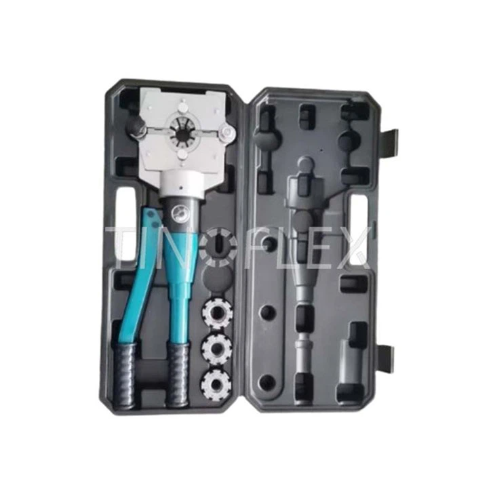
Hose ID: 1/4-3/4
Quantity of dies: 4sets
Maximum opening: Can be opened
Mold length: 25mm
System pressure: 30Mpa
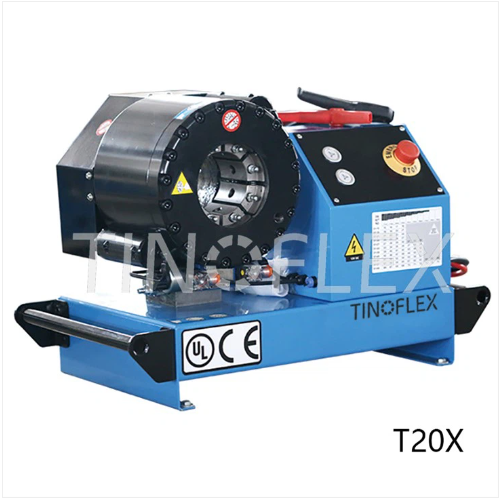
Model: T20X
Crimping range (mm): 4-65
Max hose size ID (inch): 11/2" (4SH)
Max crimping force (kN): 2200
Die set type: 20

Model: T38Q
Crimping range (mm): 4-95
Max hose size ID (inch): 2" 6SP
Max crimping force (kN): 4200
Die set type: 32

Hose ID: 1/4-3/4
Quantity of dies: 7sets
Maximum opening: Can be opened
Die length: 25mm
System pressure: 30Mpa
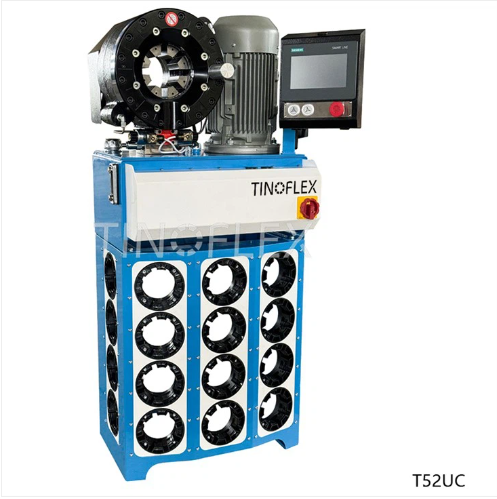
Model: T52UC
Crimping range (mm): 4-90
Max hose size ID (inch): 2"4SP
Industrial hose size: 3"
Cycle time 10mm(s): 3
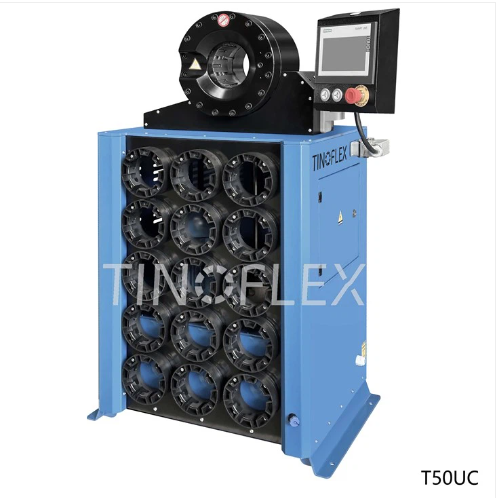
Model: T50UC
Crimping range (mm): 4-87
Max hose size ID (inch): 2" 4SP
Max crimping force (kN): 2200
Die set type: 32

Model: T50MS
Crimping range (mm): 4-87
Max hose size ID (inch): 2" 4SP
Max crimping force (kN): 2200
Die set type: 32
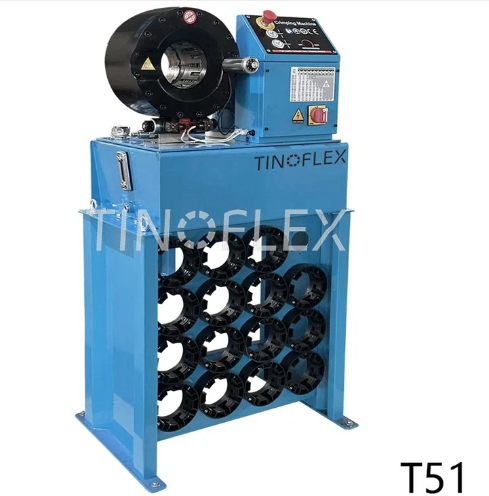
Hydraulic Hose Crimping Machine
Model: T51
Crimping range (mm): 4-87
Max hose size ID (inch): 2" 4SP
Max crimping force (kN): 2200
Die set type: 32

Model: T20HP
Crimping range (mm): 4-75
Max hose size ID (inch): 11/2"(4SH)
Max crimping force (kN): 1400
Die set type: 20
What is Pneumatic Hydraulic Hose Crimper
A hydraulic crimper is a tool used to connect the ends of two cables, wires, or other similarly flexible materials such as hydraulic hoses to a matching hose end. This tool allows the user to create crimped connections through a hydraulic fluid mechanism to transfer force from the user to the tool.
Hydraulic Hose Crimper Dies Specification
|
Dies No.# |
Crimping range (mm) |
Length (mm) |
|
6* |
6.0 – 8.0 |
55 |
|
8* |
8.0 – 10.0 |
55 |
|
10* |
10.0 – 12.0 |
55 |
|
12* |
12.0 – 14.0 |
55 |
|
14 |
14.0 – 16.0 |
55 |
|
16 |
16.0 – 19.0 |
55 |
|
19 |
19.0 – 22.0 |
55 |
|
22 |
22.0 – 26.0 |
70 |
|
26 |
26.0 – 30.0 |
70 |
|
30 |
30.0 – 34.0 |
70 |
|
34 |
34.0 – 39.0 |
75 |
|
39 |
39.0 – 45.0 |
75 |
|
45 |
45.0 – 51.0 |
90 |
|
51 |
51.0 – 57.0 |
90 |
|
57 |
57.0 – 63.0 |
100 |
|
63 |
63.0 – 69.0 |
110 |
|
69 |
69.0 – 75.0 |
110 |
The safety rules in operating hydraulic crimpers generally revolve around knowing which areas of the machine are safe and which could potentially harm the user.
Although risks come with all industrial machinery, knowing which areas of the crimping machine can inflict injury is an important precaution. The area where the crimping dies can be found should be familiar to the operator. Any foreign object inside this will be crushed by the pressure exerted by the hydraulic hose crimper, including the operator's hands. This is known as the Exclusion Zone.
Although there is minimal risk of injury, you should also be aware of the 30mm area in the frontal area of the die set. This is generally called the Caution Zone. Most hydraulic hose crimpers have a slow die movement coupled with a semi-automatic operation as additional safety measures. This means that when you release the button, the die will stop moving, giving you complete control of the die set's movement.
Operators using hydraulic hose crimpers should always be alert and free from any potential distractions. There should also only be one operator at all times, and their hands should be visible to themselves at all times.
How To Maintain A Hose Crimper
Cleaning – Make sure to clean your hose crimper before and after use. Keep the crimper free from debris, dirt particles, and other contaminants. Well-maintained hose crimpers operate smoothly and aren't a hazard to the user. However, keep in mind that you should avoid using water, solvents, and abrasives when cleaning the hose crimper. You could try using a small brush for the crimping head's inner section but never use compressed air.
Lubrication – Hose crimpers of any kind, especially those that are sophisticated, automated, or used in heavy industrial settings, should be cleaned and lubricated after every eight hours of operation. Retract the crimping die for lubrication. For the cone-shaped surfaces within the cylinder, use a small brush to lubricate them. Remember that although over-lubrication may interfere with the machine's proper operation, the lack of lubrication also does the same by damaging the sliding surfaces. As such, the key is to lubricate the hose crimper moderately.
The conical flanges should be lubricated at least once a day.
Apply lubricant on both sides of the crimping dies using a small brush.
Never lubricate the piston rod.
Oil Change – For newly acquired hose crimpers, its hydraulic oil should be changed after the first 500 hours of operation. After this, the oil should be changed either after every 1,000 hours of operation or once a year.
Never overfill the oil tank.
Handle the waste oil according to the local bylaws
Using a 20μ filter to pump oil into a tank is highly recommended because new oil inside drums are not pure.
Master Spring Change – The master die springs of hose crimpers wear down. As such, they should be replaced after every 100,000 crimps. Replacing these requires special tools and professional experience and should not be attempted by anyone untrained.
How to Crimp a Hydraulic Hose in 8 Easy Steps
Measure and cut the hose
Measure the length of the hose that you need and cut it to the necessary size with a hose saw. If a cut-off length for the fitting is available, use the cut-off length for each side of the assembly and subtract it from the overall length of the hose assembly. If cut-off length is not available, the following can be done to ensure proper hose length.
Place hose on measuring table at the desired overall length. Mark the fitting where the cut length should be if not designated on the fitting. Run the hose along the measuring table then place other fitting at the beginning of the measuring table and place hose against the fitting. Once the hose is lined up correctly with the cut length of the fitting, mark your cut line on the hose.
Mark insertion depth
Marking insertion is very important to make sure the fitting has been inserted correctly. Determine insertion depth of the fitting by utilizing a hose insertion depth block. This mark will indicate when the crimp fitting is properly seated on the hose. If you do not have an insertion block available, you can determine insertion depth by subtracting the cut off from the overall length or by lining the fitting up against the hose and then marking the hose. Once you insert the fitting, the ferrule should meet the line marked on the hose.
Clean the hose
Use a foam projectile to get out all the debris that might have accumulated during the hose cutting (known as pigging the hose). Cleaning the hose will reduce contamination and hose assembly failure. If you do not have the pigging equipment, blowing air through the hose will help, as well.
Load the correct specifications and proper die
If you have a programable crimper, load the specific crimp spec called out for the hose and crimp fitting you are assembling. Pick out the correct crimp die specified for your hose and crimp fitting. Doublecheck data before crimping.
Place the hose in the crimping machine
Push the end of the hose into the crimping machine and through the die so that the hydraulic hose fitting appears above the die. The top of the hose, now concealed inside the fitting, should not be above the die. Most fittings are full crimp fittings but there are some that have a specific crimp length designated for that particular fitting. In some cases, they are called bubble crimp fittings.
Crimp the hose
Your hydraulic hose is now ready to begin crimping. Turn on the machine. The cylinder head will slowly move down. As it pushes the collar, the collar compresses the die. Do not touch the machine until the collar is firmly at the bottom of the die. The machine should then stop.
Verify the crimp diameter is correct
Make sure the hose is finished to the correct crimp diameter by checking the chalk mark that you made on the hose. If it is no longer at the base of the fitting, it means the hose or the fitting moved during the crimping process. However tight it may seem, this is not a good crimp. Otherwise, if the chalk mark is in place, you have successfully crimped the ends of the hydraulic hose. Then check the diameter with calipers measuring on the flats of the crimp to see if your finished crimped outside diameter matches the one called out for your specific hose and fitting.
Cap and tag the hose assembly
After you clean the hose again, it is a good idea to cap the assembly on both ends. You can use plastic caps or heat shrink caps. Tag the hose if requested by the client.
Types of Hydraulic Hose Crimpers
Hand-held crimpers
A hand-held hydraulic hose crimper is a portable tool used in hydraulic construction and automotive repair. It applies hydraulic pressure to create secure hose connections, preventing leaks.
These crimpers are open to accepting multiple hose sizes and are known for their precision and reliability. Regular maintenance and proper training for operators (hydraulic hose crimper users) are key to safe and effective use.
While they represent an initial investment, they are cost-effective for businesses frequently working with hydraulic hoses, allowing for in-house assembly and repair.
Bench-mounted crimper
A bench-mounted hydraulic hose crimper is a specialized machine used in industries like (hydraulic base) manufacturing units and construction.
It properly attaches hoses to fittings in hydraulic systems, ensuring leak-free connections.
These crimpers are well-known for their precision or support and high output rate.
They come with changeable die sets for different hose sizes and offer automation features for good efficiency.
Bench-mounted crimpers are ideal for businesses requiring a large number of hose assemblies of good quality.
Portable crimping machine
A simple-to-operate portable tool called a portable hydraulic hose crimper is used to crimp hydraulic hoses and fittings together securely.
For fields like agriculture and construction, its portability makes easy on-site maintenance and repair possible.
All portable crimpers deliver stable and accurate crimps to protect against leaks and the hydraulic system's quality.
They include friendly operation and adjustable die sets to handle various hose sizes and types.
Portable hydraulic hose crimpers are a useful tool for experts in the field since regular maintenance is necessary to ensure safe and effective functioning.
Power source: Some tools are manually operated, while others are powered by electricity, air or hydraulics. Consider the most convenient and practical power source for your application.
Durability: Look for a tool that is built to last and withstand heavy use. A quality tool will last longer and require fewer repairs or replacements.
Safety: Consider the safety features of the tool, such as automatic release, guards and emergency stop buttons.
Ease of use: Choose a tool that is easy to operate and maintain. A user-friendly design can help increase productivity and reduce downtime.
Brand reputation
Only purchase tools from reputable brands that have a proven track record of producing high quality, durable products.
Warranty
Always look for tools that come with a warranty in case of defects or problems.
Budget
Compare prices and features of different tools and choose one that fits your budget and offers the features you need.
Our Factory
Our vision at TINOFLEX is to redefine fluid transfer systems with forward-thinking solutions that enhance efficiency, reliability, and sustainability. We aspire to be the preferred partner for businesses seeking seamless fluid transfer operations and improved productivity.


FAQ
Hot Tags: pneumatic hydraulic hose crimper, China pneumatic hydraulic hose crimper manufacturers, factory, Hose Cutting Machine, Toothed Blades, industrial hydraulic hose crimper, industrial crimping machine, mobile hydraulic hose crimping machines, pneumatic crimping press
You Might Also Like


Send Inquiry